


FIFA World Cup 2026 Predictions — discover data-driven analysis, simulations, and expert insights revealing which teams are statistically favored to lift the trophy in North America.
Introduction-Setting the Stage for FIFA World Cup 2026 Predictions


The world is buzzing, stadiums are nearly confirmed, and squads are sharpening tactics. So naturally, FIFA World Cup 2026 Predictions are everywhere — but not all predictions are equal.
While fans argue on social media, data models quietly build thousands of simulations based on:
-
power rankings
-
squad depth
-
fatigue risk
-
historical performance
-
tactical metrics
And despite a 48-team format, the numbers suggest something fascinating:
The football giants are still statistically ahead — but the gap is shrinking.
Official event background: see FIFA’s overview
FIFA World Cup 2026 Predictions and the New 48-Team Reality
This tournament changes almost everything:
-
Longer tournament
-
Round-of-32 added
-
More travel
-
More knockout pressure
Yet one truth remains:
Depth wins tournaments.
Teams that rotate without performance drop-offs hold the advantage — especially across seven high-intensity matches.
Why Supercomputers Shape FIFA World Cup 2026 Predictions
Forget “gut feel.” These predictions rely on:
-
100,000+ tournament simulations
-
Player value coefficients
-
Expected Goals (xG) trends
-
Opponent strength weighting
-
Injury probability models
For a deeper look at analytics cultures, check resources like the Opta methodology page or educational breakdowns from sports data communities such as Stats Perform.
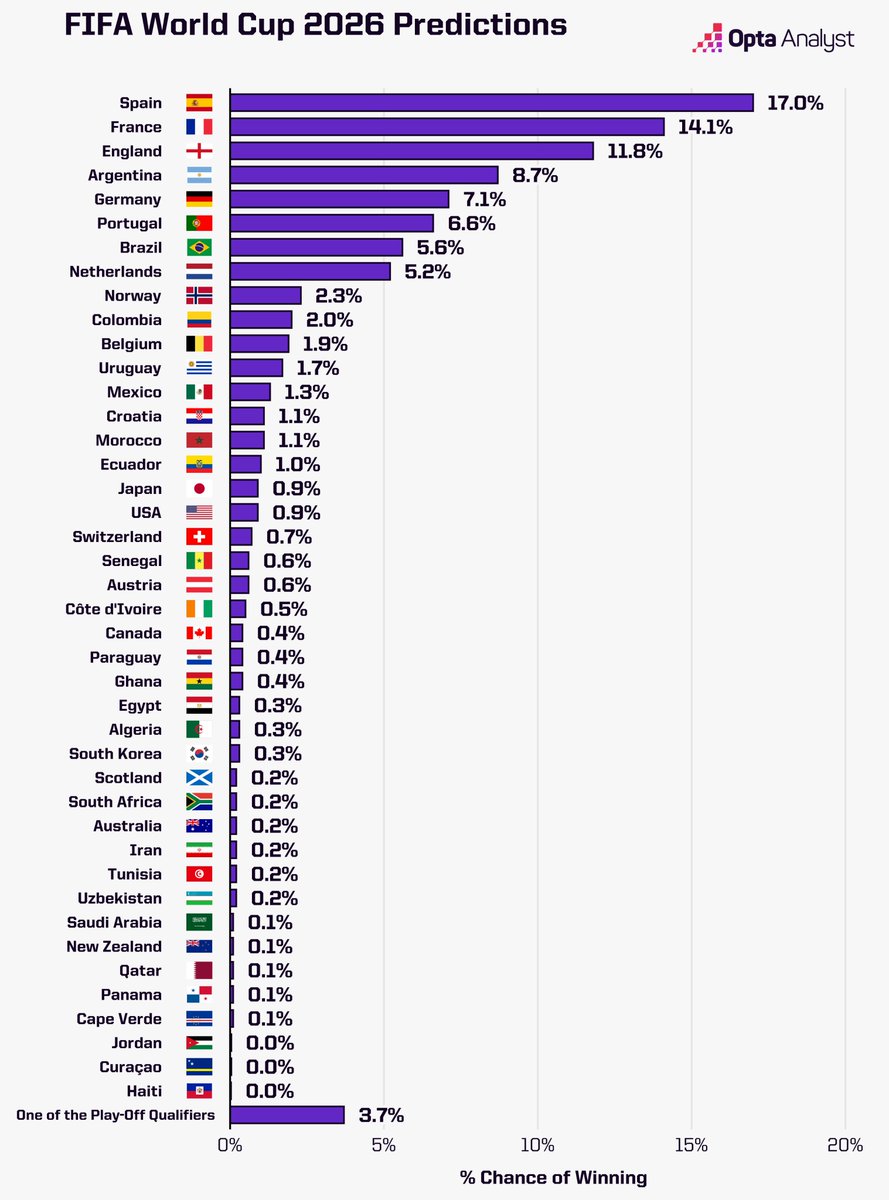

The result isn’t a fortune-telling trick — it’s probability. And probability usually wins… eventually.
The chart shows Opta Analyst’s predicted chances for each national team to win the 2026 FIFA World Cup. The countries are listed from highest to lowest probability, with purple bars representing each team’s percentage chance of becoming champion.
- Spain sits at the top with the highest projected chance to win: 17.0%.
- France follows closely at 14.1%, and England is third at 11.8%.
- Argentina (8.7%), Germany (7.1%), Portugal (6.6%), Brazil (5.6%), and Netherlands (5.2%) round out the next group of strong contenders.
Below them, several competitive teams such as Norway, Colombia, Belgium, and Uruguay fall in the 2%–1% range, meaning they have outside shots but are less favored.
Many nations — including the USA, Japan, Switzerland, Senegal, and Austria — are shown with under 1% chances, indicating they are considered long shots.
Toward the bottom, numerous teams have 0.3% or lower, reflecting very slim odds. Some, like Haiti and a few others, show 0.0%, meaning the model believes their chances to win are virtually nonexistent.
Interestingly, the chart also includes “One of the Play-Off Qualifiers” with a 3.7% chance — suggesting that an as-yet-unknown team emerging from playoff rounds collectively has a better statistical shot than many confirmed participants.
Overall, the visualization emphasizes that while several teams are competitive, a small group of traditional football powers dominate the probability of winning.
🇫🇷 FIFA World Cup 2026 Predictions: France as the Probability Juggernaut
France leads many simulations because:
-
bench players equal starters
-
defensive structure stays steady
-
elite transitional attack
Their performance drop-off is the lowest among contenders. In a system demanding seven matches, that’s gold.
Key takeaway: France can rotate — and still dominate.
🇪🇸 FIFA World Cup 2026 Predictions: Spain and the Power of Control
Spain evolved beyond possession for possession’s sake. They now blend:
-
vertical runs
-
relentless pressing
-
creative wide attackers
They top Europe in high turnovers leading to shots, showing that pressing — not just passing — defines them.
Spain looks patient, ruthless, and sustainable.
🇦🇷 FIFA World Cup 2026 Predictions: Argentina’s Resilience Factor
Argentina rank highly because they simply refuse to collapse.
-
consistent ELO stability
-
reliable defensive block
-
mentally composed in pressure matches
They don’t always flash — but they rarely break.
🏴FIFA World Cup 2026 Predictions: England’s Deep-Run DNA
Say what you want — England rarely lose to weaker opposition.
In a 48-team field, avoiding upset risk becomes an enormous competitive advantage.
-
disciplined defending
-
elite midfield transition
-
psychological maturity
They’re efficient, calculated, and statistically dependable.
🇺🇸 FIFA World Cup 2026 Predictions: USMNT and the Host Advantage (H2)
Host nations historically gain:
-
10–15% performance boost
-
greater confidence
-
better familiar pitch rhythm
But…
Their win probability remains modest due to limited Tier-1 knockout success.
Still, reaching the quarterfinal is fully realistic- and that would be historic momentum for American soccer.
More about U.S. soccer development
Hidden Variable: Travel Fatigue in FIFA World Cup 2026 Predictions
North America is massive. Teams could fly thousands of miles between matches.
Models now calculate:
-
reduced sprint output
-
increased muscle strain risk
-
delayed recovery cycles
Depth will no longer be a luxury — it becomes survival.
Top 8 Teams in FIFA World Cup 2026 Predictions
| Rank | Team | Titles | Strength Snapshot | Prediction Score |
|---|---|---|---|---|
| 1 | France | 2 | Deep squad | ⭐⭐⭐⭐⭐ |
| 2 | Spain | 1 | Tactical control | ⭐⭐⭐⭐⭐ |
| 3 | Argentina | 3 | Defensive resilience | ⭐⭐⭐⭐ |
| 4 | England | 1 | Consistency | ⭐⭐⭐⭐ |
| 5 | Brazil | 5 | Individual brilliance | ⭐⭐⭐ |
| 6 | Germany | 4 | Rebuild potential | ⭐⭐⭐ |
| 7 | USA | 0 | Host boost | ⭐⭐ |
| 8 | Portugal | 1 | Attack-heavy | ⭐⭐ |
The table shows tiers — not guarantees.
Understanding Charts in FIFA World Cup 2026 Predictions
Modern charts illustrate:
-
probability distribution curves
-
fatigue-adjusted performance forecasts
-
bracket difficulty maps
They highlight strategic truths rather than predicting exact match outcomes.
Why Surprises Still Break FIFA World Cup 2026 Predictions
Football isn’t math alone.
-
one red card
-
one injury
-
one tactical gamble
And a favorite can crumble instantly.
Which… is exactly why we watch.
FAQs About FIFA World Cup 2026 Predictions
1️⃣ Are predictions guaranteed?
No. They estimate probability, not destiny.
2️⃣ Why do big nations rank higher?
Depth, history, and consistency.
3️⃣ Can hosts win?
Possible — but historically rare.
4️⃣ Do analytics really help?
Yes — they reveal blind spots and trends.
5️⃣ Which factor might matter most?
Travel fatigue plus squad rotation strategy.
6️⃣ Can a dark horse shock everyone?
Always. Tournament football loves chaos.
Conclusion-The Real Meaning of FIFA World Cup 2026 Predictions
The FIFA World Cup 2026 predictions point toward familiar giants — but the expanded format introduces chaos, surprises, and unforgettable storylines.
Fans will debate. Analysts will adjust models match-by-match.
And when the ball finally rolls, numbers meet emotion — and anything can happen.
FIFA World Cup 2026 Predictions don’t spoil the story — they deepen it.
They show why France leads, why Spain rises, why Argentina stabilizes, and why England quietly lurks.
But they also remind us:
Football remains gloriously unpredictable.
Follow official schedules and updates:
And stay tuned — because when the whistle blows, numbers meet nerves, and legends are born.