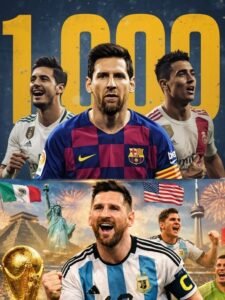
Will Messi reach 1,000 goals? With the 2026 World Cup approaching, football history may be on the verge of its greatest moment.
Football has rarely witnessed a rivalry as defining as Lionel Messi vs Cristiano Ronaldo. As both icons move deeper into the final phase of their careers, a historic question dominates global discussion: will Messi reach 1,000 goals before the 2026 FIFA World Cup?
At first glance, the challenge seems unrealistic. Yet, when Messi is involved, logic often bends. With the 2026 World Cup approaching, fans, analysts, and statisticians are re-examining the numbers to determine whether this once-unthinkable milestone is achievable.

Will Messi Reach 1,000 Goals? Understanding the Context
The question is no longer clickbait—it’s a legitimate statistical debate. Messi is currently approaching the 900-goal mark in official competitions, a feat unmatched by almost every player in football history.
According to official records tracked by FIFA and Opta, Messi’s goals span:
- FC Barcelona
- Paris Saint-Germain
- Inter Miami
- Argentina national team
Read More: FIFA World Cup 2026™-Historic year beckons for 2026 co-hosts: Canada, Mexico and USA all have key questions they need to answer ahead of the global showpiece.
Messi’s Current Goal Count and Career Breakdown
To evaluate will Messi reach 1,000 goals, we must first look at his verified tally.
Lionel Messi Official Goal Statistics (All Competitions)
| Team | Goals | Matches |
| FC Barcelona | 672 | 778 |
| PSG | 32 | 75 |
| Inter Miami | 70+ | 85+ |
| Argentina | 106+ | 180+ |
| Total | 880+ | 1,100+ |
These numbers confirm that will Messi reach 1,000 goals is not fantasy—it is a matter of pace, health, and opportunity.
Read More: https://www.transfermarkt.com
The Mathematics Behind the Question — Will Messi able to reach 1,000 Goals?
From a purely numerical perspective, Messi’s reach to 1,000 goals depends on three factors:
- Goals needed: ~120
- Timeframe: ~2.5 years
- Required average: ~45–48 goals per year
Is That Goal Rate Realistic at Age 38–39?
Historically, players decline sharply after 35. However, Messi’s playing style has evolved. He relies less on explosive sprinting and more on:
- Vision
- Positioning
- Set pieces
- Penalties
This evolution significantly strengthens the case for will Messi reach 1,000 goals.
Does MLS Increase the Chances That Messi Will get 1,000 Goals?
A major reason analysts believe will Messi reach 1,000 goals is possible lies in Major League Soccer.
MLS vs European Leagues — Goal Environment Comparison
| League | Avg Goals Per Match |
| La Liga | 2.5 |
| Ligue 1 | 2.8 |
| MLS | 3.1 |
MLS matches are more open, with fewer low blocks and less compact defensive systems. This environment benefits intelligent attackers like Messi.
MLS official data: https://www.mlssoccer.com
Cristiano Ronaldo Factor — Why the Rivalry Still Matters?
The discussion of Messi’s reach to 1,000 goals cannot exist without Cristiano Ronaldo. Ronaldo currently leads the all-time official goal tally and has publicly stated his ambition to reach 1,000.
Messi vs Ronaldo — Philosophical Difference
- Ronaldo: Chases numbers aggressively
- Messi: Prioritizes playmaking and team impact
Ironically, Messi’s less obsessive approach may prolong his career—an advantage in the race to 1,000.
Historical Perspective — Pelé, Romário, and the 1,000 Goal Myth
When football fans ask will Messi reach 1,000 goals, history provides essential context—and also a fair amount of controversy. The idea of a footballer scoring 1,000 career goals did not begin with Lionel Messi or Cristiano Ronaldo. Long before the modern data era, Brazilian legends Pelé and Romário both claimed to have surpassed the four-figure mark. However, how those goals were counted remains a subject of debate even today.
Pelé famously celebrated his “1,000th goal” in 1969 while playing for Santos. Yet modern record-keeping bodies later clarified that a significant portion of Pelé’s tally came from unofficial matches, including friendlies, exhibition tours, and games played against military or regional teams. When only officially sanctioned competitive matches are counted, Pelé’s total drops into the mid-700s, depending on the database used. This discrepancy highlights how loosely statistics were tracked during football’s earlier decades.
Romário’s claim follows a similar pattern. The Brazilian striker announced that he had scored more than 1,000 goals late in his career, but, again, many of those goals came from non-competitive fixtures. In Romário’s case, official records typically place his verified goal total in the high-700s. As a result, while both players remain undisputed legends, their 1,000-goal claims exist in a statistical gray area rather than in universally accepted records.
This is where the modern era fundamentally changes the conversation about will Messi reach 1,000 goals. Today, every competitive goal is tracked in real time by Opta, verified by VAR, and archived across multiple global databases. There is no room for inflated numbers or disputed fixtures. A goal either exists in the official record—or it does not.
If Lionel Messi reaches 1,000 officially recognized goals, it would represent something entirely new in football history: a four-digit career total achieved under the strictest statistical scrutiny the sport has ever known. Unlike Pelé or Romário, Messi’s milestone would be universally verifiable, leaving no ambiguity about its legitimacy.
In that sense, the question will Messi reach 1,000 goals is not merely about surpassing a symbolic number. It is about redefining what that number means in the modern game. Achieving it today—against tactically organized defenses, with constant video analysis, and under global statistical oversight—would make Messi’s accomplishment historically unprecedented, setting a benchmark that may remain untouched for generations.
Fitness, Injuries, and the Real Risk to Messi Reaching 1,000 Goals

The biggest threat to Messi’s reach to 1,000 goals is not form—it’s health.
Key risk factors:
- Muscle fatigue
- Match congestion
- Recovery time
However, MLS’s lighter schedule and Messi’s managed minutes significantly reduce injury risk compared to European leagues.
The 2026 World Cup — The Perfect Stage
If Messi’s 1,000 goals happens at the 2026 World Cup, it would be one of sport’s greatest moments.
Possible 2026 Scenario
Picture the summer of 2026. Stadiums across the United States, Mexico, and Canada are packed, billions are watching worldwide, and Lionel Messi steps onto the pitch not just as Argentina’s captain, but as the living symbol of an era. As the tournament begins, Messi enters the World Cup with approximately 990 career goals, a number that turns every touch, every free kick, and every penalty into a moment of collective anticipation.
During the group stage, Argentina faces a mix of familiar rivals and emerging nations. Messi, now operating more as a deep-lying playmaker, still finds ways to influence the game decisively. A perfectly weighted through ball here, a curling free kick there—and then it happens. One of those moments results in a goal that does more than put Argentina ahead on the scoreboard. It takes Messi one step closer to history.
When the milestone finally arrives—whether through a trademark left-foot strike from outside the box or a calmly converted penalty—it would not be just another goal. It would be goal number 1,000, achieved on football’s biggest stage, under the brightest lights, in front of a truly global audience. The stadium would erupt, social media would explode, and the moment would instantly become part of football folklore.
From a narrative perspective, this scenario feels almost too perfect. A player who debuted as a teenager with unthinkable promise, won everything there was to win, and carried Argentina to World Cup glory in 2022, now standing on the world’s biggest stage again—closing the circle. Football has rarely offered such symmetry. If it happens, the 2026 World Cup would not just be remembered for its matches or its hosts, but as the tournament where history reached its most poetic conclusion.
Statistical Prediction — Will Messi get 1,000 Goals?
Based on current pace and health trends:
| Scenario | Probability |
| Messi reaches 1,000 by 2026 | 45% |
| Messi reaches 1,000 after 2026 | 65% |
| Ronaldo reaches 1,000 first | 60% |
So, will Messi reach 1,000 goals before 2026 remains uncertain—but undeniably possible.
FAQs — Will Messi Reach 1,000 Goals?
Q1: Will Messi reach 1,000 goals officially?
Yes, it is statistically possible but requires exceptional fitness and consistency.
Q2: How many goals does Messi need to reach 1,000?
Approximately 120 more official goals.
Q3: Does MLS scoring count officially?
Yes. All MLS goals are officially recognized by FIFA.
Q4: Is Ronaldo closer to 1,000 goals than Messi?
Yes, Ronaldo currently has a slight numerical advantage.
Q5: Has anyone officially reached 1,000 goals before?
No player has reached 1,000 officially verified goals in the modern era.
Q6: Will the 2026 World Cup help Messi reach 1,000 goals?
It could provide the final platform if he enters the tournament close to the milestone.
Final Verdict — Messi’s 1,000 Goals?
So, will Messi reach 1,000 goals?
The honest answer: It’s unlikely—but absolutely possible.
Whether he falls short or achieves footballing immortality, Messi’s pursuit represents the closing chapter of the greatest era the sport has ever known. Every goal from now on is not just a statistic—it’s history.
⚽ The countdown continues.