


Introduction
FIFA AI Technology World Cup 2026 introduces AI-powered offside detection, 3D player avatars, Football AI Pro, and referee body cameras to ensure fairness, accuracy, and transparency.
Offside decisions have long been one of the most divisive elements in modern football. Marginal calls, unclear camera angles, and inconsistent interpretations have repeatedly sparked controversy, undermining trust in officiating and overshadowing the sport itself. As the world prepares for the most expansive tournament in history, the FIFA AI Technology World Cup 2026 emerges as a decisive answer to these challenges, delivering unprecedented precision, transparency, and competitive balance.
Unveiled through a strategic collaboration between FIFA and Lenovo at CES 2026, FIFA’s latest AI-driven systems represent a structural transformation of how football is analyzed, officiated, and experienced. With 48 teams competing across multiple host nations, artificial intelligence is no longer an enhancement—it is a necessity.
Why Offside Controversies Became a Global Problem
In recent tournaments, offside decisions have increasingly relied on marginal measurements involving millimeters and split-second movements. Even with VAR in place, fans and players often struggle to understand how decisions are reached, leading to frustration and skepticism.
The FIFA AI Technology World Cup 2026 directly addresses these issues by replacing estimation with data-driven certainty. By leveraging real-time AI processing, the new systems remove ambiguity from one of football’s most contentious rulings.
AI-Powered 3D Player Avatars: Redefining Offside Detection
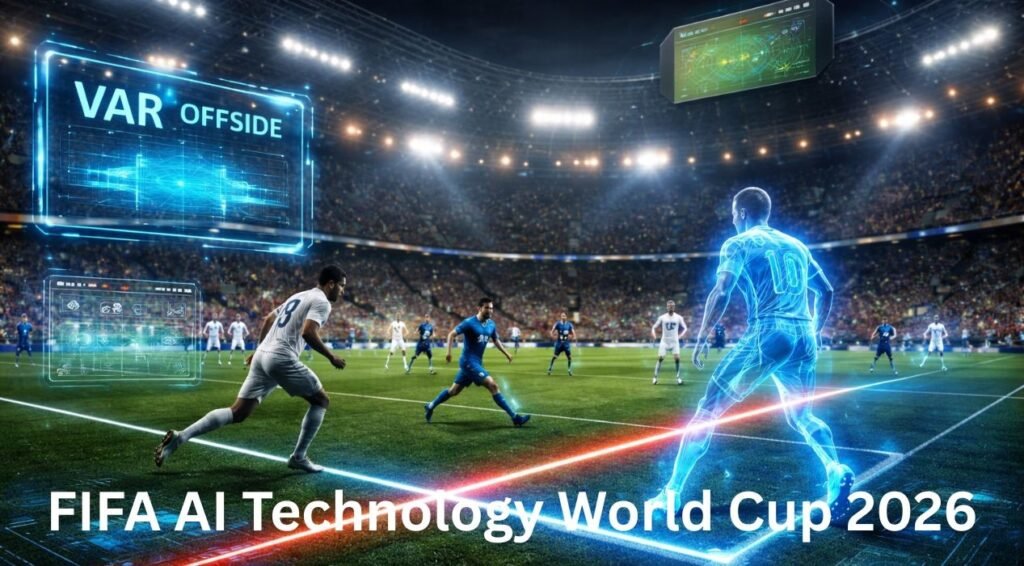
At the heart of this transformation is FIFA’s next-generation semi-automated offside detection, powered by AI-generated 3D player avatars.
How the Technology Works
- Multiple high-speed tracking cameras capture every player’s movement
- Artificial intelligence reconstructs each player as a precise 3D digital model
- The system tracks body position, limb extension, and alignment in real time
- Offside lines are calculated with millimeter-level accuracy
This innovation ensures reliable decisions even during fast transitions, crowded penalty areas, or visually obstructed plays—situations that traditionally caused officiating errors.
These 3D visualizations are also integrated into VAR reviews and television broadcasts, allowing fans to see exactly how decisions are made rather than relying on abstract explanations.
Explore more: Footbal Technology
Football AI Pro: Tactical Intelligence for Every Team
Beyond officiating, the FIFA AI Technology World Cup 2026 introduces Football AI Pro, a generative AI knowledge assistant available to all 48 participating teams.


What Football AI Pro Delivers
Football AI Pro analyzes millions of football data points, transforming them into:
- Tactical summaries in natural language
- Video-based opponent analysis
- Player performance trends
- Interactive 3D tactical visualizations
The system can be used before and after matches, ensuring compliance with competition regulations while dramatically improving preparation quality.
Democratizing Elite Analytics
For the first time in World Cup history, every national team—regardless of financial resources—has access to the same elite-level analytics. This eliminates long-standing disparities and reinforces FIFA’s commitment to competitive fairness.
Read More on Smarter Technology for All
VAR Evolution: Faster, Clearer, More Trustworthy Decisions
VAR remains a critical tool, but its effectiveness depends on speed and clarity. Under the FIFA AI Technology World Cup 2026, VAR receives significant upgrades:
- AI-assisted frame selection
- Automated player tracking during review
- Real-time visualization overlays
These enhancements reduce decision time while increasing confidence among referees and spectators alike. Clearer visuals and faster rulings minimize match disruptions and maintain game flow.
Explore more: video-assistant-referee-var
Referee View: AI-Enhanced Transparency on the Pitch
Another breakthrough innovation is the enhanced Referee View system—a body-mounted camera worn by match officials.
Now upgraded with AI-based video stabilization, Referee View delivers:
- Reduced motion blur
- Sharper first-person footage
- Smoother live and replay visuals

Why Referee View Matters
- Offers unmatched transparency
- Helps audiences understand referee positioning
- Strengthens trust in decision-making
For broadcasters and fans, this feature provides an immersive perspective previously unavailable in elite football.
Why AI Is Essential for a 48-Team World Cup
The expansion to 48 teams introduces logistical complexity across venues, climates, and competitive levels. The FIFA AI Technology World Cup 2026 ensures consistency by:
- Standardizing officiating accuracy
- Equalizing tactical preparation tools
- Reducing human error across matches
Artificial intelligence functions as a competitive equalizer, supporting referees and teams without replacing human judgment.
Future Fan Access to FIFA AI Technology
While current implementations prioritize teams and officials, FIFA has confirmed plans to extend AI-powered insights to fans in the future.
Potential fan-facing features include:
- Personalized match analytics
- Interactive offside explanations
- AI-generated post-match summaries
- Enhanced second-screen experiences
This evolution positions the FIFA AI Technology World Cup 2026 as a blueprint for the future of football consumption.
Setting a New Global Standard for Football Technology
FIFA’s AI strategy is not a short-term experiment. It establishes a scalable framework likely to influence domestic leagues, continental competitions, and future World Cups.
Key outcomes include:
- Reduced controversy
- Greater officiating trust
- Tactical parity
- Improved fan understanding
- Long-term technological sustainability
Conclusion: Precision Restores Fair Play
Offside controversies have threatened football’s credibility for too long. The FIFA AI Technology World Cup 2026 delivers a decisive response—combining AI precision, transparency, and fairness to protect the integrity of the game.
By integrating advanced AI into officiating, analysis, and broadcasting, FIFA ensures that the 2026 World Cup will not only be the biggest in history, but also the most accurate, transparent, and trusted.
Frequently Asked Questions (FAQ)
What is FIFA AI Technology World Cup 2026?
The FIFA AI Technology World Cup 2026 refers to FIFA’s deployment of advanced artificial intelligence systems during the 2026 FIFA World Cup. These technologies support referees, teams, and broadcasters through AI-powered offside detection, 3D player avatars, tactical analytics, and enhanced VAR decision-making.
How does AI improve offside decisions at the 2026 World Cup?
AI improves offside decisions by using high-speed tracking cameras and AI-generated 3D player avatars. These systems reconstruct players’ body positions in real time, allowing offsides to be detected with millimeter-level precision, even during fast or visually obstructed plays.
What are 3D player avatars in FIFA officiating?
3D player avatars are digital reconstructions of players created using artificial intelligence. They allow referees and VAR officials to see exact body positioning, limb alignment, and movement frames, ensuring more accurate and transparent offside decisions.
What is Football AI Pro and who can use it?
Football AI Pro is a generative AI analytics platform provided by FIFA to all 48 participating national teams. It analyzes millions of football data points to deliver tactical insights, match analysis, video breakdowns, and 3D visualizations. Teams can use it before and after matches, but not during live play.
Does Football AI Pro give unfair advantages to bigger teams?
No. One of the core goals of Football AI Pro is data democratization. FIFA provides equal access to every team, regardless of budget or technical resources, ensuring competitive balance across all nations.
How is VAR changing for the 2026 World Cup?
VAR at the 2026 World Cup will be enhanced with AI-assisted tools, including automated player tracking, faster frame selection, and real-time 3D visual overlays. These upgrades reduce review times and improve clarity for referees and viewers.
What is Referee View and how does it work?
Referee View is a body-mounted camera worn by match officials. Enhanced with AI stabilization software, it delivers smooth, first-person footage that improves broadcast transparency and helps fans understand refereeing decisions from the official’s perspective.
Will fans be able to see AI decisions during matches?
Yes. AI-generated visuals, including offside lines and 3D animations, will be shown during VAR reviews on television broadcasts and stadium screens, allowing fans to clearly understand how decisions are made.
Is artificial intelligence replacing referees?
No. AI is designed to support referees, not replace them. Final decisions remain with human officials, while AI provides precise data, visual clarity, and analytical support to reduce errors and controversy.
Will FIFA AI technology be available to fans in the future?
FIFA has confirmed plans to extend select AI-powered features to fans in the future, including interactive match analysis, personalized insights, and AI-generated post-match summaries.
Why is AI especially important for the 48-team World Cup?
With more teams, matches, venues, and referees than ever before, AI ensures consistency, accuracy, and fairness across the entire tournament. It helps standardize officiating and analytics at a global scale.
Is FIFA AI Technology World Cup 2026 a long-term strategy?
Yes. FIFA views AI as a foundational pillar for the future of football. The systems introduced in 2026 are expected to influence domestic leagues, continental competitions, and future World Cups.