


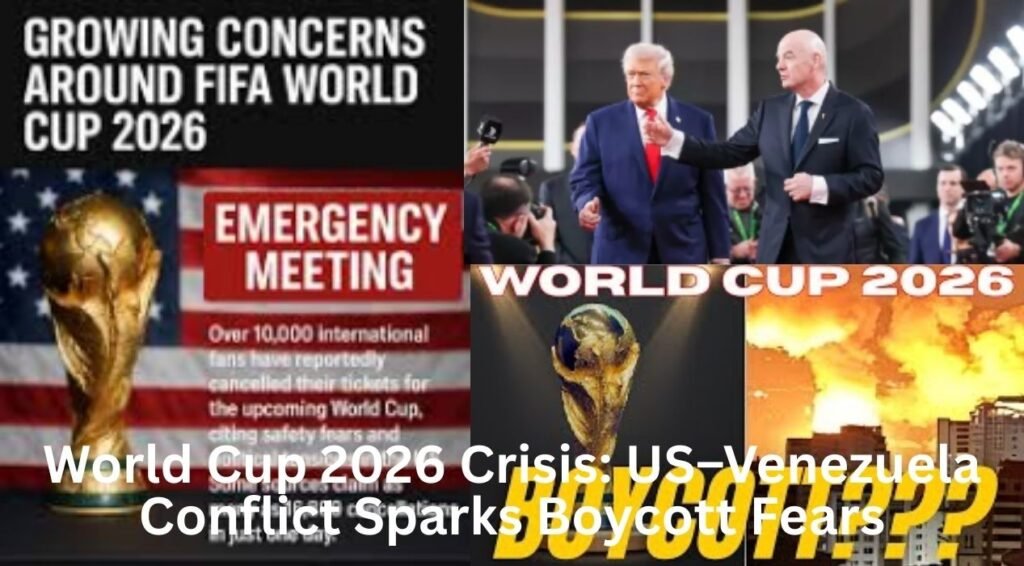
Negative headlines, massive curiosity
Bad news spreads fast. When global politics collides with the world’s biggest sporting event, curiosity goes into overdrive. Right now, phrases like World Cup 2026 Crisis, Boycott World Cup 2026 and Countries boycotting World Cup 2026 are trending for one reason—fear. Fear that the beautiful game could once again be dragged into political chaos.
Sports, politics, and global consequences
Football is supposed to unite. Politics tends to divide. When those two worlds overlap, Google Discover readers click instinctively, searching for answers, clarity, and—most importantly—hope.
The United States–Venezuela Tension Explained Simply
What actions by the United States triggered global concern
The United States’ involvement in Venezuela—through sanctions, diplomatic pressure, and strategic influence—has reignited global debate. While these actions are political, their ripple effects have reached unexpected places, including international sports discussions.
Why international sports bodies are paying attention
FIFA operates under strict rules of political neutrality. When a host nation is seen as influencing or destabilizing another footballing nation, alarm bells ring. Not because FIFA wants drama—but because instability threatens tournaments.
The Actions of the United States in Venezuela Put the 2026 World Cup in Very Bad Company
Historical examples of politics hurting major tournaments
From Olympic boycotts to football bans, history shows that politics can poison global events. Once comparisons start, reputations suffer. That’s why analysts say the World Cup 2026 Crisis being associated with controversy instead of celebration.
Why FIFA hates political interference
FIFA’s core rule is simple: governments stay out of football operations. Any perception—real or exaggerated—creates pressure FIFA would rather avoid.
Visit: FIFA statutes on political neutrality
Can FIFA Suspend the World Cup 2026 Crisis Due to US Intervention in Venezuela?
FIFA statutes on political neutrality
Technically, FIFA can suspend or sanction federations—not tournaments—if political interference is proven. Suspending a World Cup is extremely unlikely.
Realistic vs unrealistic suspension scenarios
A full suspension? Almost impossible. Increased scrutiny, warnings, or diplomatic mediation? Very possible.
Could the United States Lose the 2026 World Cup Because of Its Conflict with Venezuela?
Host country responsibilities
Host nations must ensure safety, neutrality, and fair access. Failure in these areas invites criticism—but removal is a nuclear option.
What “losing hosting rights” would actually mean
In reality, FIFA would redistribute matches to Canada or Mexico long before stripping the US entirely.
Countries Boycotting World Cup 2026—Is It Possible?
What a World Cup boycott looks like
A boycott means teams refuse to participate. It’s rare—and costly.
Past boycotts and lessons learned
Boycotts hurt athletes more than governments. That’s why most football associations avoid them.
World Cup Boycott vs Football Unity
Why players and fans usually resist boycotts
Players train their entire lives for one moment. Fans wait generations. Walking away is never easy.
Sponsors and broadcasters hold the real power
Money talks. And sponsors don’t like instability.
What Are Venezuela’s Chances of Qualifying for the 2026 World Cup?
Venezuela FIFA World Cup qualifiers explained
With the expanded format, CONMEBOL teams now have more slots than ever.
Expanded slots change everything
Venezuela’s chances have never been better. Talent plus opportunity equals hope.
Why Will the 2026 World Cup Be Held in Three Countries?
USA, Canada, Mexico—shared hosting model
Logistics, scale, and financial efficiency drove the decision.
Risk reduction through multi-host strategy
If one country faces issues, others can compensate. Smart planning.
Explore more: FIFA official World Cup page
FIFA World Cup 2026 Host Country Structure
How matches are distributed
The US hosts most matches, while Canada and Mexico host key stages.
Why this protects the tournament
Decentralization equals resilience.
What Will Be the Opening Match of the 2026 World Cup?
Expected host and stadium
Likely in the United States, possibly at a newly upgraded mega-stadium.
Political symbolism of the opening game
FIFA may choose a “neutral unity” message to set the tone.
FIFA World Cup 2026 Schedule Overview
Expanded format explained
48 teams. More matches. Longer festival.
What fans should expect
More drama, more underdogs, more stories.
World Cup 2026 Groups and the New Tournament Format
More teams, more drama
Smaller groups increase intensity.
How this affects competitiveness
Every match matters.
World Cup 2026 Tickets—Will Politics Affect Prices?
Demand vs uncertainty
Controversy increases curiosity—and demand.
Smart buying strategies
Buy early. Stay flexible.
What Will Be the Economic Impact of the 2026 World Cup?
Billions in tourism and infrastructure
Hotels, flights, jobs—economic impact is massive.
Who gains the most economically
Host cities and small businesses win big.
The Solution: How FIFA Can Protect the 2026 World Cup
Diplomacy, decentralization, and dialogue
FIFA must stay proactive, neutral, and firm.
Keeping football above politics
The solution isn’t silence—it’s smart governance.
Conclusion
The fear surrounding the FIFA World Cup 2026 host country situation is real—but so is the solution. While US–Venezuela tensions raise uncomfortable questions, history, structure, and financial reality strongly suggest the tournament will go on. The key lies in FIFA’s ability to act early, communicate clearly, and protect football’s neutrality. Crisis creates clicks—but solutions build trust. And football, above all, deserves unity.
FAQs
- Can the World Cup 2026 really be boycotted?
Highly unlikely. Financial and sporting costs are too high. - Is FIFA considering moving matches from the USA?
Only as a contingency, not a primary plan. - Does Venezuela have a strong chance to qualify?
Yes, expanded slots significantly improve their odds. - Will World Cup 2026 tickets become more expensive?
Demand may increase prices, but politics alone won’t drive them. - Why is the 2026 World Cup safer with three host countries?
Because risks are spread, ensuring stability.